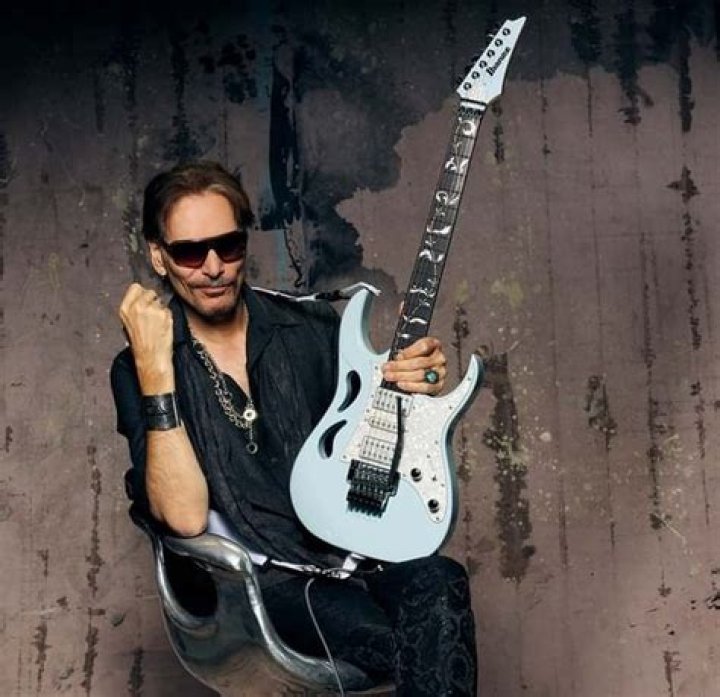
During his employment by Frank Zappa, Vai transcribed and played very rhythmically complex music, believing that if started slow and perfected, any piece of music could be played. Vai’s first solo album, Flex-able, began his career as a solo artist in 1984.
Steven Siro Vai ( /vaɪ/; born June 6, 1960) is an American guitarist, composer, singer, songwriter, and producer. A three-time Grammy Award winner and fifteen-time nominee, Vai started his music career in 1978 at the age of eighteen as a transcriptionist for Frank Zappa, and played in Zappa’s band from 1980 to 1983.
Steve Vai (on guitar in between the drums and keyboard, to the right), Frank Zappa and band during a concert at the Memorial Auditorium in Buffalo, New York (October 25, 1980) In 1978, Vai sent both a notated transcription of Frank Zappa’s ” The Black Page “, and a recording of his college band, Morning Thunder, to Zappa.
Here I Go Again. Jump to navigation Jump to search. “Here I Go Again” is a song by British rock band Whitesnake. Originally released on their 1982 album, Saints & Sinners, the power ballad was re-recorded for their 1987 self-titled album.
Who sang “Here I go again”?
For other uses, see Here I Go Again (disambiguation). ” Here I Go Again ” is a song by British rock band Whitesnake. Originally released on their 1982 album, Saints & Sinners, the power ballad was re-recorded for their 1987 self-titled album. The song was re-recorded again the same year in a new “radio-mix” version, …
Single versions. There are several different versions of the song, all recorded officially by Whitesnake . The original version from the 1982 Saints & Sinners album with Jon Lord on Hammond organ and Bernie Marsden and Micky Moody on guitar (5:03)
When did Steve Vai perform at the Astoria?
In December 2001, Vai recorded two performances at The Astoria in London, with his band The Breed (composed of former David Lee Roth bandmate Billy Sheehan, guitarist/pianist Tony MacAlpine, guitarist Dave Weiner, and drummer Virgil Donati ). This live show was released independently in DVD format as Steve Vai: Live at the Astoria, London in 2003, and was Vai’s first of many successful live concert DVD projects. In 2004, Vai released twelve tracks from the DVD in an online only release.
In 1985, Vai joined David Lee Roth’s post- Van Halen band as lead guitarist, together with former Talas bassist Billy Sheehan on bass; and former Maynard Ferguson drummer Gregg Bissonette on drums. The foursome’s debut album Eat ‘Em and Smile, released on July 7, 1986, was both a critical and commercial success, reaching number four on the Billboard 200 albums chart and selling over two million copies. Guitar World magazine editor Brad Tolinski commented on Vai’s playing at the time, saying that “Steve Vai’s guitar wizardry is so profound that in earlier times he would have been burned as a witch.” Retrospectively, Eat ‘Em and Smile is frequently evaluated as one of the greatest rock albums of the 1980s. The group’s Eat ‘Em and Smile Tour began in August 1986 and continued through February 1987.
A three-time Grammy Award winner and fifteen-time nominee, Vai started his music career in 1978 at the age of eighteen as a transcriptionist for Frank Zappa, and played in Zappa’s band from 1980 to 1983. He embarked on a solo career in 1983 and has released eight solo albums to date.
In 2008, Vai’s song “ For the Love of God ” and “Halo Theme (MJOLNIR Mix)” were featured as downloadable tracks for the game Guitar Hero 3.
After the release, Vai held a world tour in which he played the entire Passion and Warfare album, along with material from the new release. The tour would continue during the first half of 2017. In 2016, Vai played an uncredited guitar solo on the track ” Go! ,” from the album Junk by French electronic band M83.
The release, which Vai himself produced and engineered, won him his second Grammy award for Best Pop Instrumental Album in February 2002. While most widely recognized for his stature as a rock guitar player, Vai is also a musical composer fluent in the composition and arranging of orchestral music.
ADVERTISEMENT
From 1985 to 1990, Vai recorded Passion and Warfare at his home studio, his second studio solo album. After leaving Roth’s band in 1989, Vai bought out of his Capitol Records contract and signed on with Relativity Records for the release of Passion and Warfare, which was completed shortly after he began recording the guitar parts for Whitesnake ‘s Slip of the Tongue album, where he replaced the injured Adrian Vandenberg.
What album did Steve Vai make?
Three decades after its release, Vai takes you inside the making of Whitesnake’s Slip of the Tongue, the album that sent the band into uncharted territory. (Image credit: Paul Natkin/Getty Images) Steve Vai will be the first to tell you how uncanny his charmed life in rock ‘n’ roll has been. While his work as a game-changing guitar expressionist …
Vai left the Alcatrazz gig to join David Lee Roth in spearheading the singer’s wildly successful post-Van Halen solo group, a gig he left in 1989 only to have yet another coveted lead guitar role “fall in his lap” (as he tells it), this time with one of the biggest bands of the ’80s: Whitesnake.
