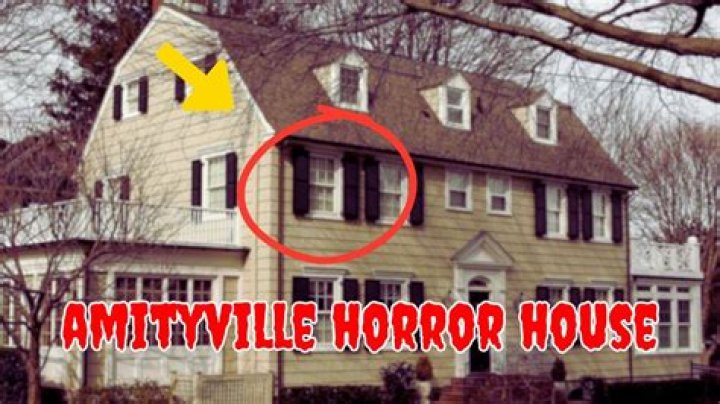
So, if you’re as big of a horror genre fan as you claim to be, scroll down and check out the real story behind the Amityville Horror! The house where it all started. This house is located in a suburban neighborhood in Amityville which is why it’s known as the Amityville house.
Described as a “Stately Center Hall Colonial,” the home is made up of five bedrooms and four bathrooms. The property sits on Amityville River and features a large boat house with a boat slip and two-car garage. Renovations of the property took place as recently as October.
Two members of the Suffolk County Coroner’s Office remove one of six bodies that were found shot in Amityville on Nov. 14, 1974. The day they moved, the couple had a priest bless the house. But George claimed the holy man felt an unseen hand slap him in the sewing room and heard a voice say “Get out.”
(Information courtesy of the Amityville Historical Society). Myth – The red room was the gateway to hell. Fact – The red room was nothing more than a little area underneath a stairwell that the DeFeo children sometimes stored their toys or used as storage.
What was the inspiration for the movie Amityville?
The ‘paranormal’ phenomena experienced by George and Kathy Lutz served as inspiration for Jay Anson’s 1977 book, The Amityville Horror, as well as for the original 1979 movie and the 2005 remake (you’ve seen it, Ryan Reynolds stars as Ronnie DeFeo). Numerous other films, documentaries and books were created about the Amityville house, and that’s why all future owners of the property had trouble keeping people away.
What they said is that whatever dark forces were in the house, they followed them that night; they never went into detail about what happened, but they never returned to 112 Ocean Avenue either. George and Kathy left all of their belongings there and put the house back on the market.
There are some U.S. addresses that can conjure up spine-tingling fear with each mention. Think 10050 Cielo Drive in California (known as the Sharon Tate murder house ), 333 East Wonderview Avenue in Colorado (the inspiration for Stephen King’s The Shining ), 5481 County Road in Wisconsin ( Frank Lloyd Wright’s iconic Taliesin estate, …
Zooming In on the Stanley Hotel, Stephen King’s Inspiration for ‘The Shining’. The Winchester House — The Haunted Mansion that Inspired the Name of Supernatural’s Winchester Brothers.
The ‘evil eyes’ of the home, which is how people used to refer to the two attic windows, were also redone to tone down the evil — a bit late for that, but things were starting to look positive for the infamous murder house.
It hit the market with an asking price of $850,000, and eventually sold in February 2017, though well below ask, at $605,000.
TIME Magazine even included the house on their list of the top 10 haunted places in America, which certainly didn’t help anyone forget about all that happened.
ADVERTISEMENT
Why was Amityville not filmed in the real house?
Myth – American International Pictures’ The Amityville Horror movie could not be filmed in the real house because the crew was too scared. Fact – The Village of Amityville viewed the ghost story as a hoax and did not want a film crew in their sleepy community, so they denied shooting permits.
Myth – The famed Amityville house resides on an ancient cemetery that was either abandoned or cursed. Fact – In 1913, William A. Eardeley was commissioned by the state of New York to copy down old cemetery and bible records because many of the Amityville cemeteries were either abandoned or neglected.
Myth – The red room was the gateway to hell. Fact – The red room was nothing more than a little area underneath a stairwell that the DeFeo children sometimes stored their toys or used as storage. Today, it no longer exists since a subsequent owner had renovated the basement and constructed over it.
Within a year, the Moynahans needed a bigger home because, like most families, theirs grew in size. While their new home was being built, they moved their small cottage (see image below) down only a matter of a hundred yards and lived there until the construction was completed.
Fact – The Shinnecock Indians resided nowhere near Amityville. Besides, all of the Indians on Long Island were part of the Montaukett nation. It was the Europeans who placed names on the inhabitants of the local areas. Regardless, the Massapequans were the group that would have most likely visited Amityville.
According to Long Island Native American expert John Strong, author of We Are Still Here, many Indian groups lived along the tidal bays in the area, but as far as the claims about the Native Americans made in Jay Anson’s The Amityville Horror, he insists that it leads him to believe it was all an entertaining hoax.
Myth – The Catholic Church is hiding evidence that “something” existed in the Amityville house. Fact – Father Ralph Pecoraro admitted that his only contact with the Lutzes was a phone call. Questions remain whether or not he even ventured to the famed residence in Amityville.
